
The shoes are still off. Breakfast is getting cold. You have asked your toddler to get dressed three times, and the answer is a firm, tearful “No.”
Nearly every family of a young child knows this moment. At Montessori Children’s Academy (MCA), we see the same pattern in our toddler and preschool classrooms. One of the most reliable tools we use, at school and in conversations with parents, is very simple: offer two acceptable choices instead of a single command. Done well, this gives your child a small, safe sense of control while the adult stays in charge of the routine.
Why Toddlers Resist Commands
Between roughly 18 months and 3 years, children go through a major developmental shift. They begin to see themselves as separate people with their own preferences, and they want to act on them. Saying “no” is often less about defiance and more about practicing a new and exciting skill: having a will of their own.
At the same time, the parts of the brain responsible for self-regulation, flexible thinking, and planning, often called executive function, are still very immature. A toddler can feel a strong desire for independence before having the tools to manage disappointment or understand why the morning schedule can’t change.
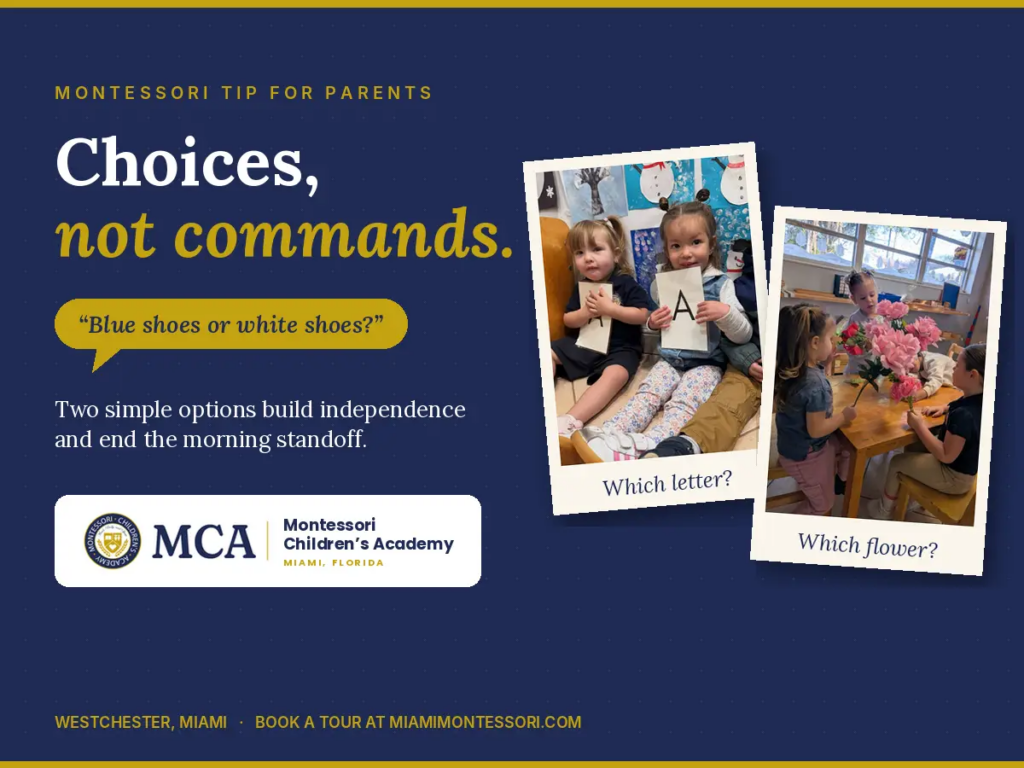
A direct command such as “Put on your shoes now” can collide with that drive for independence. A choice changes the interaction: “Would you like to wear your blue shoes or your white shoes?” The shoes still go on, but your child now plays a meaningful part in how it happens.
The Research and Philosophy Behind Offering Choices
Montessori’s “freedom within limits.” Dr. Maria Montessori observed that children thrive when they are given real freedom inside a clear, consistent structure. Freedom without limits can feel chaotic and unsafe to a young child. Limits without freedom invite resistance. Offering two options holds both at once.
Self-determination theory. Psychologists Edward Deci and Richard Ryan identified autonomy, the feeling of having some say in one’s own actions, as a core human need that supports motivation. Studies of young children consistently suggest that age-appropriate choice is associated with greater cooperation and engagement than control alone.
Reggio Emilia’s image of the child. The Reggio Emilia approach, which also shapes our program at MCA, views children as capable and competent from birth. Offering a choice tells your child, quietly and repeatedly, “I trust you to make decisions that matter.”
How to Offer Choices That Work
The most effective choices are simple, genuine, and limited.
Keep it to two. For toddlers and preschoolers, two options are usually enough. More can overwhelm a child who is tired, hungry, or already upset.
Offer choices before the struggle, not during it. Introduce a choice as a transition approaches, not after everyone is frustrated:
- “Do you want to walk to the bathroom or hop like a bunny?”
- “Would you like to clean up the blocks first or the cars first?”
Only offer choices you can truly accept. “Do you want a bath or no bath?” isn’t a real choice if a bath is needed that night. A clearer option is “Do you want bubbles in the bath or no bubbles?”
Make it visible for younger toddlers. For children around 12 to 24 months, hold up both items as you name them. This supports early language development as well as decision-making.
Keeping the Boundary Calm and Clear
Offering choices doesn’t mean children decide everything. Adults remain responsible for health, safety, schedules, and family expectations.
If your child won’t choose, respond kindly and move forward: “You’re having trouble choosing, so I’ll choose the blue shirt today.”
If your child asks for a third option, acknowledge the feeling and restate the limit: “You wanted sandals. Sandals aren’t for school today. You may choose the blue shoes or the white shoes.”
Use a warm, steady voice and avoid turning the choice into a negotiation. This approach is respectful and firm at the same time, which is what young children need most from the adults who care for them.
Everyday Routines Where Two Choices Work Best
Choices are especially useful during the routines that most often become toddler power struggles:
- Getting dressed: “The striped shirt or the green shirt?”
- Leaving the house: “Do you want to carry your lunch box or your water bottle?”
- Mealtime and snack: “Would you like banana or strawberries?”
- Clean-up: “Will you put away the books or the puzzles?”
- Bedtime: “Which two books should we read tonight?”
Choices in a Montessori Prepared Environment
In our classrooms, children make purposeful choices all day within a prepared environment: a space arranged so they can safely reach materials, choose meaningful work, and return items when they’re finished. A toddler at MCA might choose between two practical-life activities, such as folding cloths or pouring water. Over time, these small decisions build concentration, confidence, and self-direction.
You can create the same conditions at home with very little effort:
- Keep two weather-appropriate outfits within your child’s reach.
- Offer a small basket of two or three books at bedtime.
- Place snacks or cups on a low shelf so your child can help.
For more ideas, see our earlier post, Creating a Montessori “Prepared Environment” at Home.
When Choices Aren’t the Answer
Some situations call for a clear, direct instruction instead.
Safety comes first. Use short, firm language: “Stop. Hold my hand.”
Big emotions come before choices. When a child is very tired, overstimulated, or deeply upset, even two options can be too much. Lead with connection: “You’re upset. I’m here. I’ll help you get your pajamas on.” Our post How to Talk So Your Child Feels Truly Heard explores this kind of response in more depth.
Expect testing at first. Your child may push against the limit in the early days. This is a normal part of learning. Consistency matters far more than perfect wording.
Small Choices, Lasting Results
The goal isn’t to eliminate every disagreement. It’s to help your child feel respected while learning that daily routines still happen. Each small choice builds the confidence, cooperation, and independence you hope to see, both now and in the years ahead.
At Montessori Children’s Academy in Westchester, Miami, we partner closely with families so that expectations at home and at school support each other. If you’d like to see freedom within limits in action, we’d love to welcome you.
Montessori Children’s Academy — Learning Through Discovery, Building a Foundation for Life.