
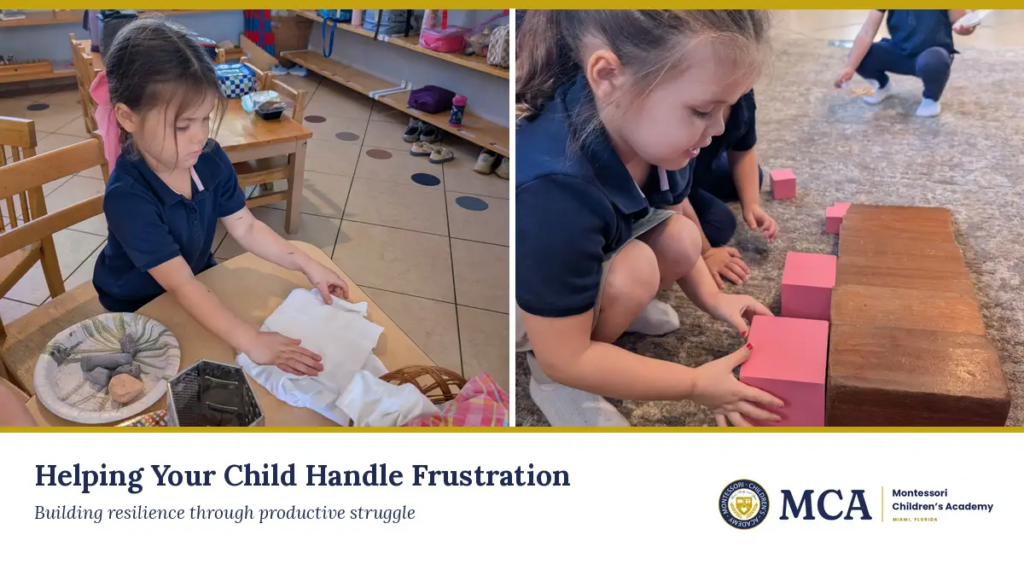
Helping Your Child Handle Frustration (and Why You Shouldn’t Rush to Fix It)
Your fourteen-month-old is trying to fit a round block into its hole. She turns it, pushes, grunts, and begins to whimper. Every instinct tells you to reach over and drop it in for her.
That instinct comes from love. Yet toddler frustration, handled well, is one of the most valuable learning experiences of early childhood. The moments just before a child succeeds, or just before she asks for help, are where developmental researchers say real growth happens. They call this productive struggle: effort at the edge of a child’s ability.
This article explains what frustration means in infants and toddlers, why stepping in too quickly can quietly undermine confidence, and how parents can help their child handle frustration in a way that builds lasting resilience.
What Toddler Frustration Is Telling Us
Frustration arises when a child’s intentions outpace her abilities. An infant can see the toy across the rug before she can crawl to it. A toddler knows exactly what he wants long before he has the words to say it. That gap between wanting and being able is normal, and it is a sign of a mind reaching forward.
The brain systems that help us manage this feeling are still under construction. The prefrontal cortex, which supports impulse control, flexible thinking, and emotional regulation, develops gradually across childhood and well into early adulthood. Young children are not yet equipped to calm themselves alone. They rely on the steady presence of an adult, a process psychologists call co-regulation.
The Harvard Center on the Developing Child describes these self-regulation skills, known as executive function, as abilities children are not born with but build through practice and supportive relationships. Each manageable frustration is a small workout for the very skills that will later help your child persist through a hard math problem or a disagreement with a friend.
The goal, then, is not a childhood without frustration. It is a childhood where frustration is met with enough support to feel safe, and enough space to be worked through.
Productive Struggle vs. Distress: How to Tell the Difference
Not all frustration is the same. Learning to tell the difference is one of the most useful skills a parent can develop.
| | Productive struggle | Distress | | — | — | — | | What you see | Focused effort, muttering, trying new angles, brief fussing | Crying that escalates, hitting or throwing, giving up entirely | | What the child needs | Time, quiet presence, perhaps a small hint | Comfort and connection first; the task can wait | | Your role | Observer and encourager | Calm anchor who helps the body settle |
The psychologist Lev Vygotsky described a zone of proximal development: the range of tasks a child cannot yet do alone but can accomplish with a little guidance. Learning happens best inside that zone. A task far too easy offers no growth; a task far too hard produces only distress. Productive struggle lives in between.
Why Rushing to Fix It Backfires
When we solve a problem the moment a child begins to struggle, we send an unintended message: this was too hard for you. Repeated often enough, children learn to stop trying and look to an adult instead.
Rushing in also interrupts concentration. Maria Montessori observed that deep, uninterrupted focus is how young children build themselves. Each rescue breaks that cycle before it can complete.
Finally, a child who never practices tolerating small frustrations has fewer tools when bigger ones arrive. Research on mindset, notably by Carol Dweck and colleagues, suggests that children who see effort as the path to mastery are more willing to take on challenges than those who see ability as fixed. Productive struggle, gently supported, is where that belief begins.
How Montessori and Reggio Emilia View Frustration
Both philosophies that guide our school treat struggle as part of learning, not a problem to be removed.
Montessori: “Help me to do it myself.” This phrase, often used to summarize Dr. Montessori’s approach, captures the adult’s role precisely. We offer just enough help for the child to succeed on her own. Montessori materials are designed with a control of error: a puzzle piece fits only one way, and the pink tower only stands when the cubes are placed in order. The material itself tells the child something is not quite right, so she can discover the solution without an adult correcting her.
Reggio Emilia: the capable child. The Reggio Emilia approach views every child as strong, competent, and full of potential. Teachers act as co-researchers, not rescuers. A problem that takes several days to solve is welcomed, because returning to it, revising ideas, and trying again is how deep understanding forms.
Together, these traditions ask adults to trust the child, prepare an environment where challenge is manageable, and observe before intervening. (Related reading: [LINK: The Power of Observation: What Parents Can Learn by Watching Quietly])
7 Ways to Help Your Child Handle Frustration
- Pause and observe. Before stepping in, count slowly to ten. Watch what your child is attempting. Often she is closer to success than she appears.
- Name the feeling. Simple words help a child connect sensation to emotion: “That block isn’t going in. You’re feeling frustrated.” Naming a feeling helps calm it and builds emotional vocabulary. (See also: [LINK: How to Talk So Your Child Feels Truly Heard])
- Offer the smallest possible help. Start with the least intervention: a question (“What if you turn it?”), then a gesture, then a demonstration. Avoid finishing the task for her.
- Stay close and calm. Your relaxed presence is itself a form of help. A child who feels safe can tolerate more challenge.
- Praise the process. Notice effort and strategy rather than the result: “You kept trying different ways.” This reinforces persistence.
- Adjust the environment, not the child. If the same frustration repeats every day, the task may be beyond reach for now. Offer a simpler version and return to it later.
- Model your own frustration. Let your child see you handle small setbacks aloud: “This jar is stuck. I’ll take a breath and try again.”
Supporting Frustration by Age
- Infants (about 6–12 months): When your baby reaches for a toy just out of reach, wait a few moments before moving it closer. Those efforts to stretch, roll, and scoot build strength and determination.
- Toddlers (12–36 months): Let your toddler work on shoes, jackets, lids, and simple puzzles. Allow extra time in your routine so you are not tempted to rush. Expect big feelings, and meet them with comfort before problem-solving. (More ideas: [LINK: Fostering Toddler Independence: Practical Steps for Miami Families])
- Preschoolers (3–5 years): Invite your child to think aloud: “What could you try next?” Encourage returning to unfinished projects the following day.
When to Step In
Supporting struggle never means leaving a child alone with overwhelm. Step in right away if there is a safety concern, if frustration turns into distress, or if your child is tired, hungry, or unwell. In those moments, connection comes first. The lesson can wait for another day.
Productive Struggle at Our Westchester Preschool
At Montessori Children’s Academy in Westchester, Miami, our teachers practice this balance every day. In our Nido infant room, babies are given freedom of movement and time to reach, grasp, and explore on their own. In Seedlings and Sprouts, toddlers practice dressing, pouring, folding, and caring for their environment, with teachers who observe first and guide gently. In Preschool, children take on longer projects, revisiting ideas and solving problems together in the spirit of Reggio Emilia.
We also value consistency between home and school. When parents and teachers respond to frustration in similar ways, children feel secure and learn more quickly that they are capable. (Related reading: [LINK: Building Your Child’s Confidence Through Real Responsibilities])
Frequently Asked Questions About Toddler Frustration
Is it normal for my toddler to get frustrated so often?
Yes. Toddlers want to do far more than their language, coordination, and self-control allow. Frequent frustration between 12 months and 3 years is a normal part of development, and it tends to ease as language and self-regulation grow.
Should I let my child struggle or help right away?
Watch first. If your child is focused and still trying, give her a little time and stay nearby. If frustration turns into distress, offer comfort first and then the smallest help needed.
How does Montessori help children build resilience?
Montessori classrooms use self-correcting materials and give children uninterrupted time to work. Children learn to notice mistakes, try again, and succeed on their own, which builds confidence and persistence.
Building Resilience for Life
The next time your child struggles, try giving the moment a little more room. Stay close, name the feeling, and wait. You may be surprised by what your child can do. Each small challenge she works through becomes part of a foundation of confidence and resilience that will serve her for life.
To see how we nurture independence and resilience in our infant, toddler, and preschool programs, we invite you to https://miamimontessori.com/book-a-tour/