
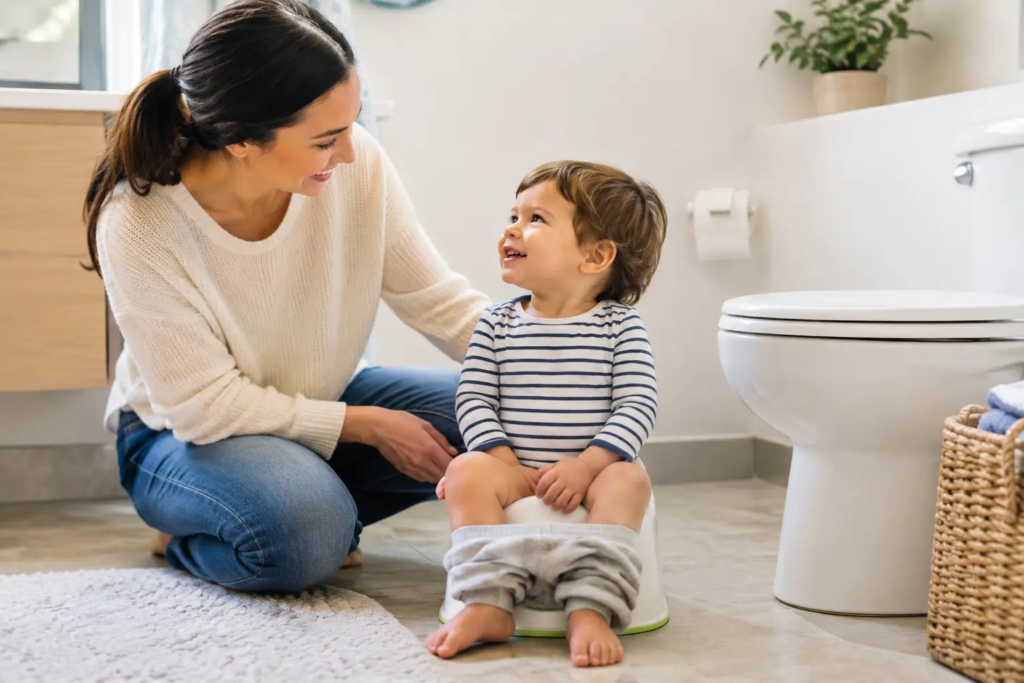
A child who pauses to watch the toilet flush, tugs at a wet diaper, or asks to use the bathroom is communicating something meaningful: “I want to understand this.” Potty Learning the Montessori Way: Following Your Child’s Readiness begins with listening to those signals rather than choosing a date on the calendar.
In Montessori education, independence grows best when children are given real opportunities, simple tools, and patient guidance. Toilet learning is one of those opportunities. It is not a test of parenting or a race with other children. It is a gradual process of learning about the body, clothing, routines, and self-care.
What readiness looks like in Montessori potty learning
Readiness is more than a child reaching a certain age. Many children show interest sometime during the toddler years, but the timing can vary widely. The American Academy of Pediatrics also recognizes that toilet learning works best when a child shows developmental signs of readiness.
You may notice that your child stays dry for longer stretches, becomes uncomfortable in a soiled diaper, can walk steadily to the bathroom, or is beginning to pull clothing up and down. They may tell you before, during, or after they need a diaper change. Curiosity counts, too. A child who wants to observe family bathroom routines is learning through everyday life.
Emotional readiness matters just as much. Your child does not need to be perfectly cooperative, but they benefit from feeling safe, unhurried, and involved. A major change, such as a new sibling, move, illness, or transition in care, may be a reason to slow down for a while.
Create a prepared bathroom environment
A prepared environment is a Montessori term for a space arranged so a child can do more independently. At home, this can be simple: a stable child-sized potty or secure toilet insert, a small step stool, easy-to-remove clothing, and a basket with underwear and wipes or washcloths.
Place these items where your child can reach them safely. A low hook for clothing and a small hamper for soiled items can make the routine feel manageable. If possible, let your child help choose underwear or place the potty in the bathroom. Small choices build ownership without making the process feel like a big performance.
Keep your language clear and calm. Name body parts and bodily functions simply, without embarrassment or teasing. You might say, “Your body is telling you it is time to use the potty. Let’s go together.” This helps your child connect a physical sensation with a next step.
Offer invitations, not pressure
A predictable routine gives children a helpful starting point. You might invite your child to sit on the potty after waking, before bath time, or before leaving the house. An invitation is different from a demand. If they say no, stay neutral and try again later.
Avoid long sitting periods or making the potty a place for screens and distractions. The goal is for your child to notice their body and take part in a real routine. A few calm minutes are enough.
Some families choose to move from diapers to underwear once their child is showing several readiness signs. Others take a slower approach with practice at home first. Either can work. What matters most is consistency, a manageable plan for your family, and communication with the adults who care for your child.
Treat accidents as part of learning
Accidents are expected. They are information, not failure. When they happen, respond briefly: “Your pants are wet. Pee goes in the potty. Let’s get cleaned up.” Then involve your child in age-appropriate cleanup, such as placing wet clothes in a hamper and choosing dry clothes.
This is not a punishment. It is a respectful way to show that actions have practical steps. Children often gain confidence when they see that a mistake can be handled calmly.
Praise can also stay focused on effort rather than outcomes. Instead of offering rewards for every success, try noticing the process: “You listened to your body,” or “You pulled down your pants by yourself.” This supports the inner motivation Montessori classrooms seek to protect.
Keep school and home working together
When your child attends a toddler program, share what you are seeing at home. Tell teachers the words your family uses, whether your child is wearing diapers or underwear, and any routines that help. In return, ask what your child does at school. Consistent language and expectations can make transitions easier.
At Montessori Children’s Academy, we view toilet learning as a partnership with families. Our educators support independence with patience and respect, while keeping parents informed about their child’s daily progress.
If your child becomes very upset, has ongoing constipation or pain, or suddenly loses skills after doing well, pause the routine and speak with your pediatrician for guidance. Most children need time, reassurance, and many chances to practice.
Your child does not need to learn on anyone else’s schedule. A calm bathroom, simple routines, and your steady confidence can help them take this important step with pride.